
Amos G. Ward Release Paths
Amos G. Ward Detention Center is Rogers County’s adult county jail. Sheriff Scott Walton’s Detention Division holds pretrial detainees and people serving shorter local sentences. Ending that booking does not always mean a person walked into the community. The next event may be bond, time served, a court-ordered discharge, another agency’s hold, or transport to ODOC intake.
For a community release made within the published window, the sheriff-linked 48 Hour Release feed is the first source. Its Release Date establishes that the county booking ended. Open the detail and review the booking number, arrest and booking dates, offenses, bond information, disposition, court date, and case number. Since the detail lacks a clear release-reason label, do not translate a bond amount or disposition into a cause the record does not state.
A sentenced prisoner may instead leave Amos G. Ward in the custody of ODOC. The Warrants and Transportation Division expressly says it transports sentenced prisoners to state intake and does not give out transport dates or status. Confirm that route after the event through the sheriff movement record, court judgment, and ODOC search. A transfer ends county custody while state custody begins.
| Possible event | Best first record | What to verify next |
|---|---|---|
| Community release or bond | 48 Hour Release detail | Rogers OSCN order and jail register |
| County sentence completion | Release Date and court judgment | Date or manner of discharge |
| ODOC transfer | Sheriff movement record | ODOC receipt and current status |
| Another hold | Sending and receiving records | Which custodian accepted the person |
Confirm an Amos G. Ward Release
Use identity fields before relying on a name. Common names, aliases, spelling changes, and short web windows can produce false matches or no match. The recent-release detail supplies more context than the grid and creates a direct Rogers County OSCN link when it has a case number.
- Search the 48 Hour Release feed by first or last name and open the matching View record.
- Compare the image, age, booking number, arrest date, booking date, offenses, and case number.
- Record the Release Date, then follow the Rogers OSCN case link for the legal order or disposition.
- Check Current Inmates if no release result appears. A person may still be held or may have left more than 48 hours ago.
- Search ODOC when a sentence or transport is plausible, and use OK VINE only as a custody-event lead.
- Request the sheriff’s jail-register and movement record when web sources conflict or the event is older.
The Rogers County released-inmate search and records path explains how county, state, federal, immigration, court, and notification sources fit together. No result in the county feed is not proof of release. It can also mean the wrong facility, an older event, a transfer, a different name, a sealed record, or a data delay.
Amos G. Ward Release Records
The rolling feed is a short public view, not a retention schedule. For an older or more exact record, use the Rogers County open-records form and identify the Sheriff’s Office or Amos G. Ward Detention Center as the custodian. Provide a full name, date of birth if known, booking or case number, and a narrow date range.
Ask for the jail-register entry, booking sheet, booking and release dates and times, date or manner of discharge, release authority, transfer destination or custodian if kept, custody-history entries, bond-release notation, and booking photograph. Under 51 O.S. section 24A.8, public jail-register fields include commitment and discharge facts when kept. The law does not compel a new custom record or force disclosure of protected material.
Submit through County Clerk Jeanne M. Heidlage, 200 S. Lynn Riggs Boulevard, Claremore, OK 74017, at rocoorr@rogerscounty.org or fax 918-923-4498. No fixed sheriff photo fee or turnaround was verified. Ask for electronic copies if available and request a cost estimate first. The county form cites Title 25, but the controlling Open Records Act is in Title 51.
For legal authority, use the Rogers County Court Clerk and OSCN. The clerk can supply a file-stamped or certified bond order, judgment and sentence, dismissal, release order, or completion entry. That order may authorize release, but the sheriff’s discharge entry is stronger on the physical county-custody endpoint.
Amos G. Ward Records Contact
Use the general sheriff line for detention routing. Records requests use the county form and clerk route. Advance transport status is not available from the Transportation Division, so request a past movement or destination record after the custody event instead.
Amos G. Ward Detention Center201 S. Cherokee Ave.
Claremore, OK
General: 918-342-9700
Correspondence: 114 S. Missouri Ave., Claremore
Two official street addresses appear in the county material. The detention facility is identified at South Cherokee Avenue, while sheriff and detention correspondence uses South Missouri Avenue. Confirm the proper destination by phone before mailing a request or visiting for a specific service.
For a Rogers County court record, the Court Clerk is at 200 S. Lynn Riggs Boulevard, Claremore, OK 74017, with phone 918-923-4961 and office hours from 8:00 a.m. to 5:00 p.m. For state custody or discharge, use ODOC records, not the county clerk.
Amos G. Ward Bond Releases
The county publishes unusually specific bond mechanics. New-charge paperwork goes to the courthouse so a judge can set bond. The jail says bond information often returns around 4:00 p.m. Cash bonds and hired bondsmen use the Night Bailbonds Door at the northwest corner of the building, on the north side of the large garage.
That timing is not a promised release hour or processing deadline. A court may set bond while another case, warrant, or hold keeps the person confined. Payment also does not prove the precise time the jail ended custody. Pair the court order and bond notation with the Release Date or requested discharge entry.
The official detention information and bond page shows the local transaction point. It also documents what happens to account funds and undelivered commissary after release, which is separate from proof that the booking ended.
Note: The stated afternoon bond-information pattern is not a fixed Amos G. Ward release schedule and should never be used as one.
Amos G. Ward Released Funds
After a community release, the former detainee must appear at the jail front office with photo identification to receive a check for the inmate-account balance. Funds are released only to that person. If custody ended through transfer instead, the balance follows the person, which supplies another local clue that “release” and “transfer” are different events.
An ordered commissary package is nonrefundable if it arrives after the person leaves, but the former detainee can pick up the items at the jail. This is a narrow, documented rule. It should not be expanded into a complete property-release policy because the sheriff did not publish a full rule for clothing, documents, medication, transportation, or all personal effects.
The sheriff’s source page shows the actual bond-door and funds procedure:
View the Amos G. Ward commissary and released-funds instructions.
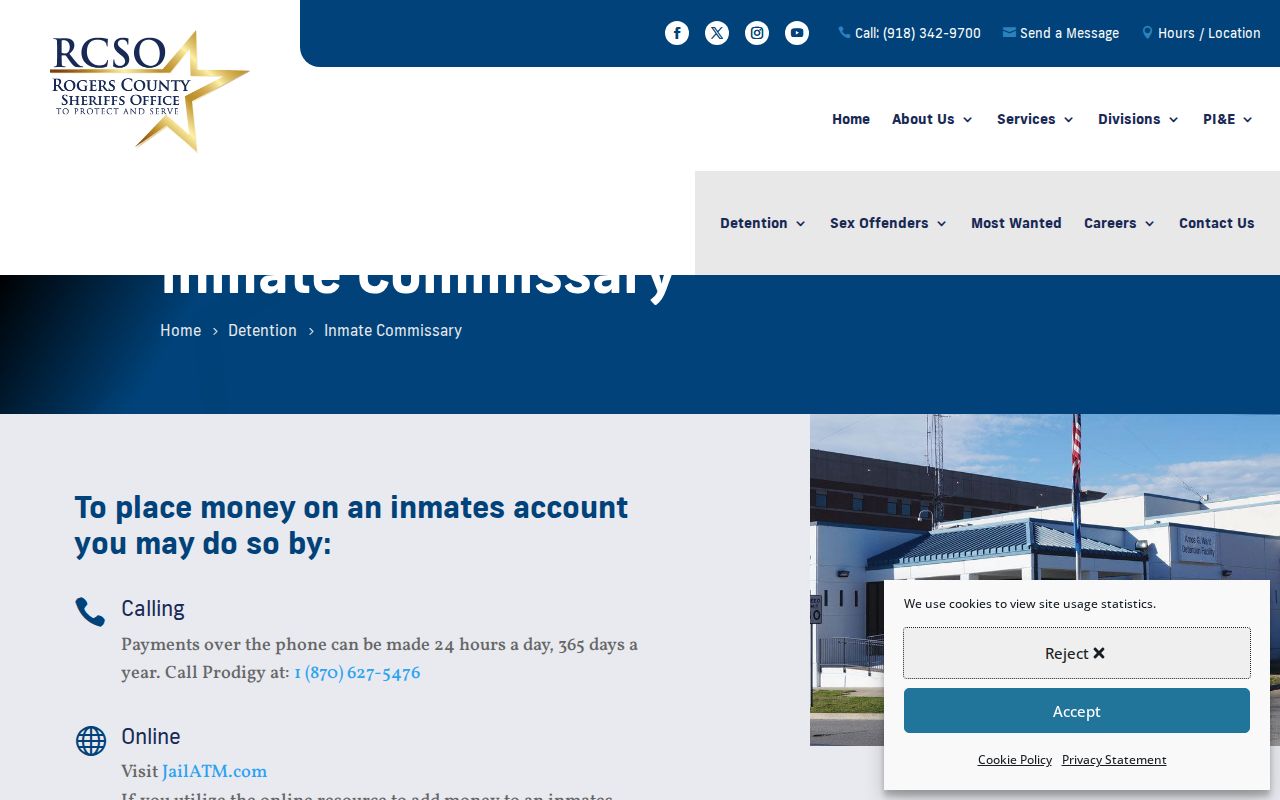
The captured official page connects post-release funds, commissary pickup, and bond access to this specific Rogers County facility.
Amos G. Ward Jail History
The Sheriff’s Detention Division says the facility was built in 2000 and holds about 250 people. It is named for Amos G. Ward, Rogers County’s twelfth sheriff, who served from 1949 through 1981. These facts place the jail in local history without changing the records path.
The facility history page also describes detention operations. It does not provide a permanent release archive. Sheriff Scott Walton’s office and its RTS application remain distinct sources: the division page explains the institution, while the feed and requested jail register document a person’s release.
The official detention overview is preserved in this facility-specific capture:
View the Rogers County Detention Division overview.
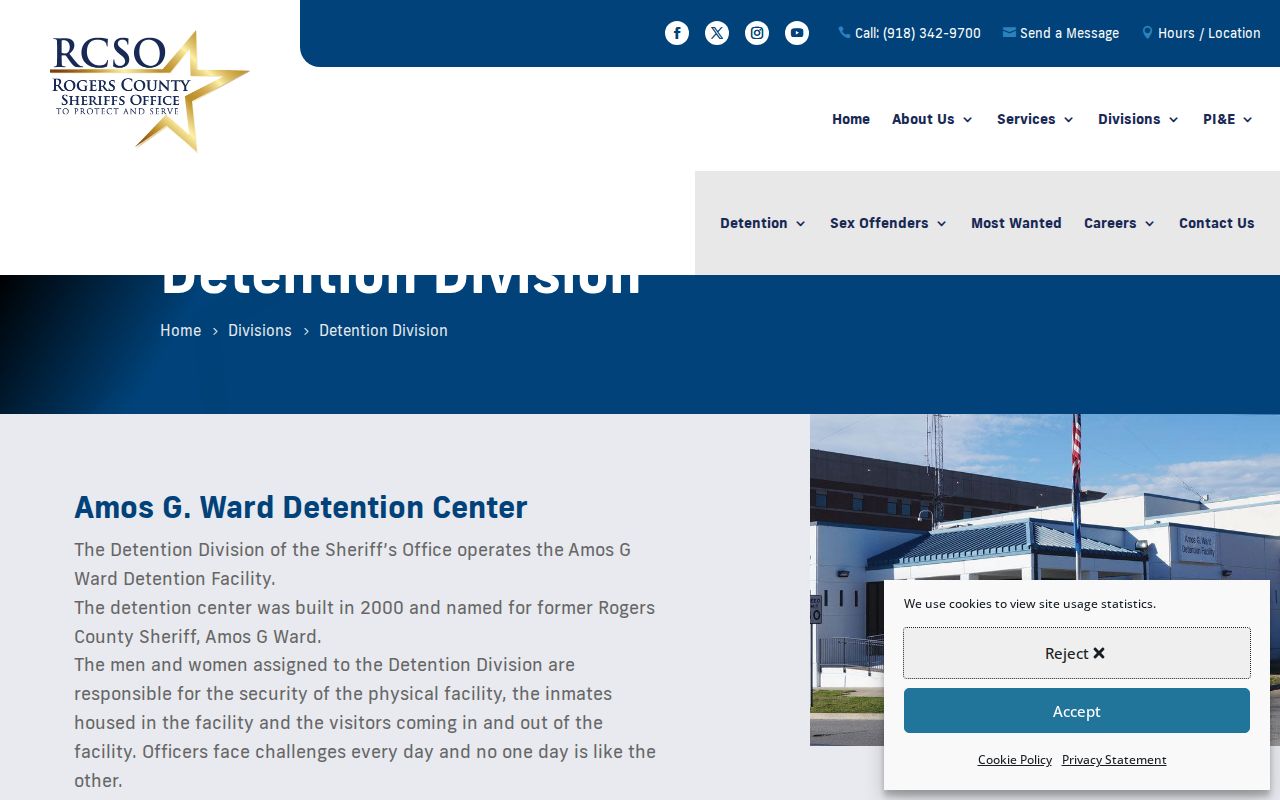
The image supports the facility facts and should not be read as a live count, release schedule, or current-custody record.